POWERED BY HELIX STRATEGY GROUP

KugelOne
THE PRECISION INSTRUMENT

For Manufacturer Discount Program Compliance

The IRA has created a landscape of regulatory toxicity. KugelOne is the specialized intelligence engine designed to navigate the Manufacturer Discount Program with surgical precision.

The Liability Paradox

Why the Manufacturer Discount Program is a Multi-Million Dollar Precision Exercise

The IRA's Manufacturer Discount Program isn't just complex—it's binary. A single misinterpretation of phase-in rules, OOP cap dynamics, or TPA invoice logic doesn't just reduce your margin—it can trigger an accrual cliff that erases your projected net price entirely.

For a mid-sized specialty portfolio, the difference between "correct" and "almost correct" is measured in tens of millions of dollars in annual GTN exposure.

Three Ways a Compliance Oversight Becomes a Financial Catastrophe

01

The Phase-In "Cliff"

The Scenario: A mid-sized manufacturer classifies itself as a "Specified Manufacturer" based on 2021-2023 aggregate sales data, accruing for the 2026 MDP liability at the favorable phase-in rate (approx. 1%).
The Oversight: Failing to account for the "Subsidiary Inclusion" rule—where the sales of a global parent or a recently acquired entity push the manufacturer over the $4.5 billion "Specified" threshold.
The Financial Result: CMS determines the manufacturer is ineligible for the phase-in. The liability for their primary Part D portfolio jumps from 1% to 10% instantly. For a high-volume specialty drug, this represents a multi-million dollar "accrual cliff" that was never budgeted.
02

The Catastrophic Acceleration

The Scenario: A Gross-to-Net (GTN) team models 2026 liability based on historical patient behavior, assuming a steady progression toward the $2,000 Out-of-Pocket (OOP) cap.
The Oversight: Overlooking the "M3P Effect" (the Medicare Prescription Payment Plan). By allowing patients to spread OOP costs throughout the year, adherence increases for high-cost therapies. Patients who previously "fell off" therapy now stay on, triggering the 20% Catastrophic Phase liability much earlier and for a larger percentage of the patient population than predicted.
The Financial Result: The manufacturer's total discount liability doubles in Q3 and Q4, leading to a massive year-end GTN adjustment that erodes the drug's net price beyond the "break-even" threshold.
03

The TPA "True-Up" Trap

The Scenario: An operations team sets up automated payment workflows for the Manufacturer Payment Portal (MPP), relying on internal Sales-In data to verify the invoices sent by the Third-Party Administrator (TPA).
The Oversight: Failing to align internal logic with the Medicare Transaction Facilitator (MTF) technical specifications for "Point-of-Sale" (POS) discount applications. Minor discrepancies in NDC-level unit counts or "True-up" adjustments go unflagged during the 7-day PDE (Prescription Drug Event) verification window.
The Financial Result: The manufacturer is legally obligated to pay the TPA-invoiced amount. By the time the audit reveals the unit-count mismatch, the window for dispute has closed, and the manufacturer is hit with statutory interest penalties and unrecoverable overpayments.
Get a Risk Assessment

Don't leave your GTN to chance. You need a Regulatory Intelligence Engine to resolve complexities faster.

Real Questions. Real Answers.

These are example outputs from our compliance intelligence engine.
Turnaround times are typical; complex cases may require additional analysis.

Phase-In Analysis~4 hours

"Our company meets the definition of a 'Specified Manufacturer' for 2025 because our 2021 Part D sales were below the statutory threshold. However, we do not qualify as a 'Specified Small Manufacturer.' Does the discount phase-in (starting at 1% in 2025) apply to all of our Part D claims, or is it limited to a specific beneficiary population?"

KugelOne Analysis:

Under the Medicare Part D Manufacturer Discount Program (MDP), the discount phase-in for a "Specified Manufacturer" is not applied to all Part D claims. Instead, it is strictly limited to applicable drugs dispensed to applicable beneficiaries who are eligible for a Low-Income Subsidy (LIS) under section 1860D-14(a) of the Act.

For all other Part D beneficiaries (non-LIS enrollees), a Specified Manufacturer that does not qualify as a "Specified Small Manufacturer" must provide the full statutory discount amounts starting January 1, 2025.

Compliance Audit & Financial Exposure Risks:
  • Beneficiary Population Restriction: The phase-in schedule (starting at 1% in 2025 and 2% in 2026) applies only to LIS-eligible individuals. For non-LIS beneficiaries, your company is liable for the full 10% discount in the Initial Coverage Phase and 20% discount in the Catastrophic Phase.
  • Specified Small Manufacturer Distinction: Only manufacturers qualifying as "Specified Small Manufacturers" receive a phase-in for all applicable beneficiaries. Since your company does not meet this definition, your financial accruals must account for the full 10%/20% liability on all non-LIS claims.
  • Eligibility Requirement: To maintain this status, the drug must have been marketed as of August 16, 2022.
2026 Specified Manufacturer Phase-In Schedule (LIS Only):
Coverage Phase2026 Discount Rate
Initial Coverage Phase2%
Catastrophic Phase2%
M3P Impact Analysis~2 hours

"Under the 2025 Part D benefit structure, does a beneficiary's participation in the Medicare Prescription Payment Plan (M3P) delay the onset of the Catastrophic Phase? Specifically, if a patient incurs $2,000 in OOP costs in January but pays over 12 months, does the manufacturer's liability for the 20% catastrophic discount begin in January or later?"

KugelOne Analysis:

Under the 2025 Part D benefit structure, a beneficiary's participation in the Medicare Prescription Payment Plan (M3P) does not delay the onset of the Catastrophic Phase or the timing of manufacturer liability for the 20% catastrophic discount.

1. Timing of Catastrophic Phase Onset

The Catastrophic Phase begins immediately once an enrollee has incurred costs that equal or exceed the annual out-of-pocket (OOP) threshold, which is set at $2,000 for 2025. In your specific scenario, if a patient incurs $2,000 in OOP costs in January, they have met the threshold for the Catastrophic Phase in January.

2. Manufacturer Liability Timing

Manufacturer liability under the Manufacturer Discount Program (MDP) is triggered by the date of service and the beneficiary's status at the time the drug is dispensed:

  • Liability Trigger: The 20% catastrophic discount applies to applicable drugs dispensed to a beneficiary who "has incurred costs... for Part D drugs in the year that are equal to or exceed the annual out-of-pocket threshold."
  • M3P Interaction: The M3P is a payment mechanism that allows beneficiaries to spread their out-of-pocket costs over the course of the year; it does not change the point at which those costs are "incurred" for the purpose of benefit phase determination.
  • January Liability: Because the $2,000 threshold was reached in January, the manufacturer's liability for the 20% catastrophic discount begins for all applicable drugs dispensed in January after that threshold is met.
Compliance and Financial Exposure Risks:
  • No Delay for Payment: Manufacturers cannot delay payment of discounts based on the beneficiary's M3P payment schedule. Discounts are advanced by Part D sponsors at the point of sale (POS).
  • 38-Day Rule: Manufacturers must pay invoiced amounts within 38 calendar days of receipt of the invoice from the CMS Third-Party Administrator (TPA).
  • Penalty Risk: Failure to pay the full 20% discount for a catastrophic claim in the required timeframe—regardless of the beneficiary's M3P status—subjects the manufacturer to a Civil Money Penalty (CMP) equal to the discount amount plus 25%.

From Billable Weeks to Actionable Minutes

The Medicare Part D Manufacturer Discount Program (MDP) is not just a list of rules—it is a complex web of interacting statutes, IRS tax codes, and operational guidance. Answering a single strategic question often requires weeks of cross-functional meetings, external legal opinions, and manual financial modeling—a process that can easily cost $15,000 to $50,000 in billable hours per issue.

The KugelOne Regulatory Engine changes the physics of compliance. Instead of retrieving simple facts, it executes complex logic chains—simulating mergers, auditing liability cliffs, and validating financial deductions in seconds.

See how our engine automates three workflows that typically take weeks of manual effort and tens of thousands in professional fees.

01340B Program Intersection

The Question

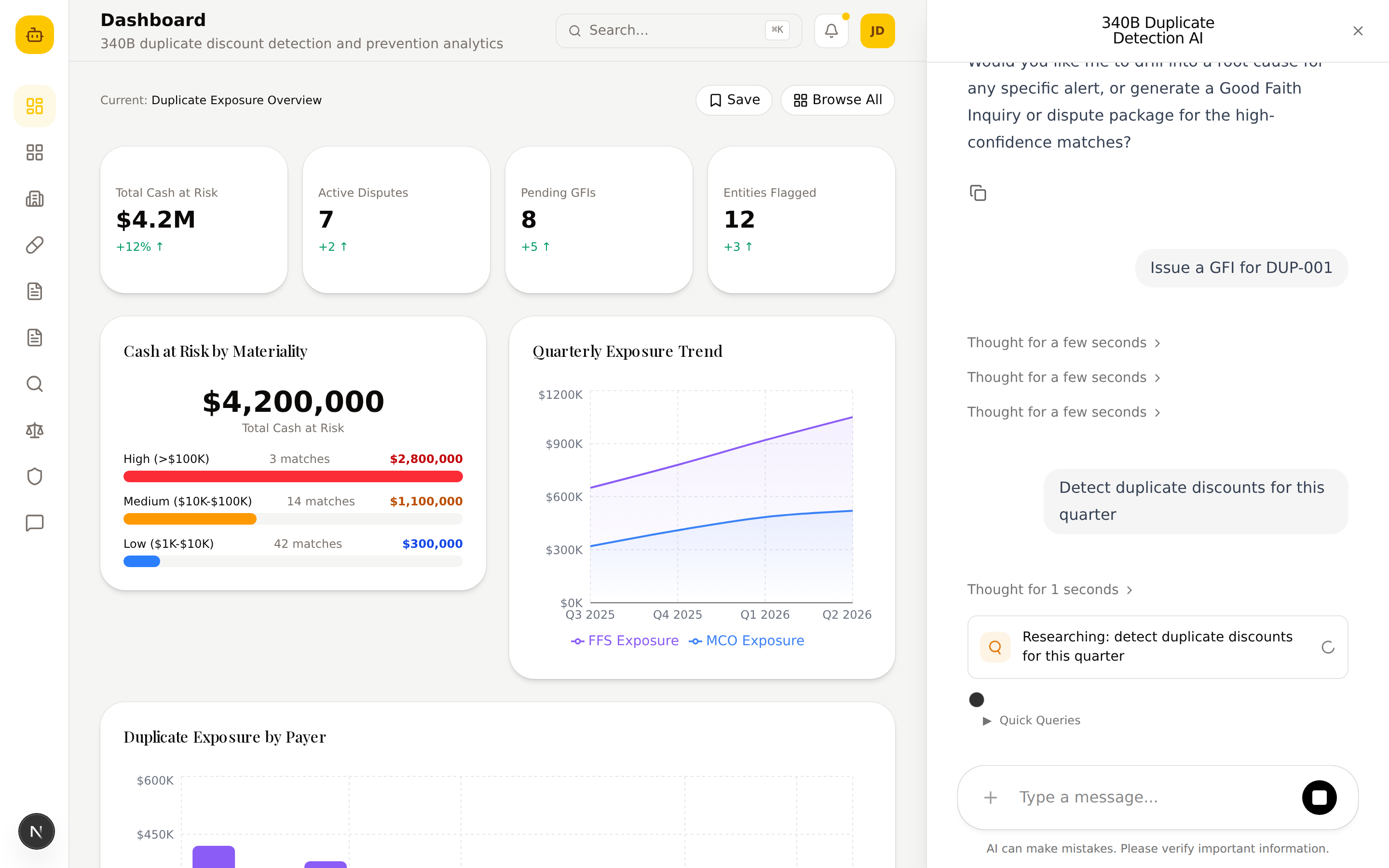
We have identified a high volume of claims originating from 340B covered entities. Under the Final MDP Guidance, are 340B claims considered 'Applicable Drugs' subject to the manufacturer discount? If a claim is dispensed by a 340B pharmacy, is there a statutory exclusion that prevents the 'Duplicate Discount' of providing both the 340B ceiling price AND the Part D Manufacturer Discount on the same unit?

KugelOne Analysis

Under the Medicare Part D Manufacturer Discount Program (MDP) effective January 1, 2025, claims originating from 340B covered entities are considered "applicable drugs" subject to manufacturer discounts if they meet the statutory criteria, and there is no statutory exclusion for "duplicate discounts" between the 340B program and the MDP.

1. Applicable Drug Status of 340B Claims

A drug is defined as an "applicable drug" under the MDP if it is a covered Part D drug approved under a New Drug Application (NDA) or licensed under a Biologics License Application (BLA) and is on the plan's formulary (or provided via exception). The guidance does not exclude drugs based on their 340B status or the setting in which they were dispensed (e.g., a 340B pharmacy). Consequently, if a drug meets the FDA approval and formulary requirements, it is an applicable drug subject to the 10% (initial coverage) or 20% (catastrophic) manufacturer discount.

2. Absence of "Duplicate Discount" Statutory Exclusion

Unlike the Medicaid Drug Rebate Program, which contains a specific statutory exclusion (Section 1927(a)(5)(C) of the Social Security Act) to prevent manufacturers from providing both a 340B discount and a Medicaid rebate on the same unit, the Manufacturer Discount Program (Section 1860D-14C) does not contain a parallel "duplicate discount" exclusion.

  • Order of Application: The MDP guidance explicitly states that the manufacturer discount is applied before any coverage or financial assistance under other health benefit plans or programs.
  • Excluded Claims: CMS has specifically identified certain claim types excluded from the MDP, such as Medicare as Secondary Payer (MSP) claims and Medicaid/IHS subrogation claims. 340B claims are not listed among these exclusions.
  • Negotiated Price: The discount is calculated based on the "negotiated price," which is the lowest possible reimbursement a network pharmacy will receive. If a 340B pharmacy's negotiated price is already lower due to its 340B status, the MDP discount is calculated on that lower price, but the obligation to provide the 10% or 20% discount remains.
Compliance & Financial Exposure

Manufacturers are required to reimburse all applicable discounts invoiced by Part D sponsors within 38 calendar days of invoice receipt. Failure to pay these discounts, including those on 340B-sourced units, results in a Civil Money Penalty (CMP) equal to the unpaid discount amount plus an additional 25%.

02Negotiated Price Calculation

The Question

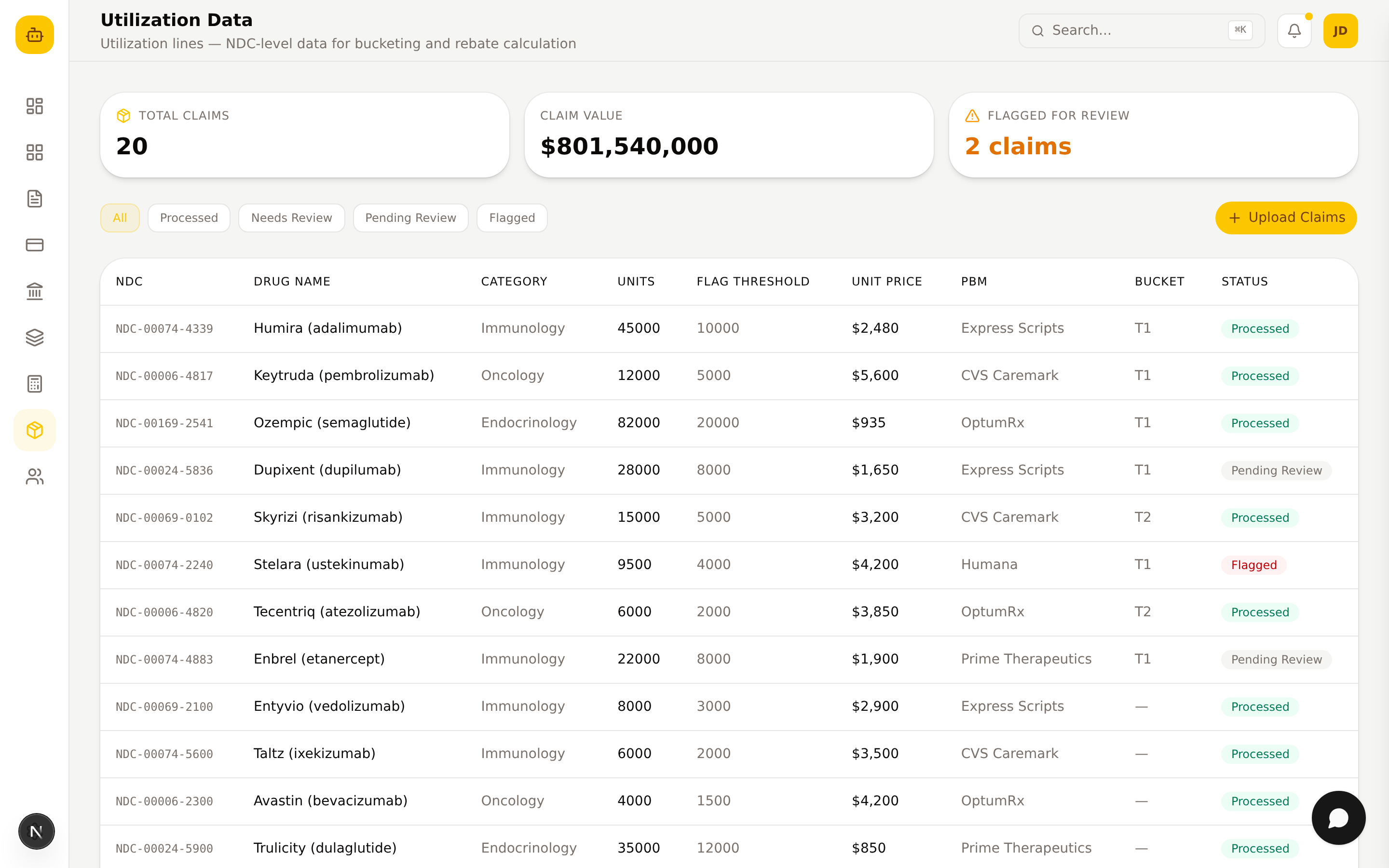
We are calculating our liability for 2025. Our Wholesaler Agreements include 'Bona Fide Service Fees' for distribution and separate 'Data Fees' for inventory reporting. Based on the definition of 'Negotiated Price' in the Final Guidance, which of these fees can be deducted from the price used to calculate the 10% discount? Does the definition of 'Negotiated Price' explicitly exclude bona fide service fees, or is the discount calculated on the gross price before these deductions?

KugelOne Analysis

Under the Medicare Part D Manufacturer Discount Program (MDP) effective January 1, 2025, the manufacturer discount is calculated based on the negotiated price as defined in 42 CFR § 423.100.

Treatment of Wholesaler Fees

Based on the regulatory definition and CMS Final Guidance, the treatment of your specific fees is as follows:

  • Bona Fide Service Fees: The guidance explicitly states that the "negotiated price" is the lowest possible reimbursement that a network dispensing pharmacy or other network dispensing provider will receive, in total, for a particular drug. It includes all network pharmacy price concessions and is reduced by all price concessions and other Direct and Indirect Remuneration (DIR) that the Part D sponsor passes through at the point-of-sale (POS). While the guidance does not explicitly list "bona fide service fees" paid to wholesalers as a deductible item, it clarifies that the negotiated price is net of all concessions passed through at the POS.
  • Data Fees: Similar to service fees, these are not explicitly listed as exclusions. The discount is calculated on the price that represents the reimbursement to the pharmacy, which includes the ingredient cost, sales tax, dispensing fee, and vaccine administration fee.
Calculation Basis (Gross vs. Net)

The discount is not calculated on the gross price before deductions if those deductions are part of the "negotiated price" definition. Specifically:

  • Included in Negotiated Price: Ingredient cost, sales tax, dispensing fees, and vaccine administration fees.
  • Excluded/Deducted: The price must be reduced by all price concessions and other DIR that the Part D sponsor passes through at the POS.
Compliance Audit Summary
  • Current Date: February 05, 2026. The MDP is currently active, having replaced the Coverage Gap Discount Program (CGDP) on January 1, 2025.
  • Discount Rates: For 2025, the standard discount is 10% in the initial coverage phase and 20% in the catastrophic phase.
  • Phase-in Exception: If your firm qualifies as a "Specified Manufacturer" or "Specified Small Manufacturer," your 2025 liability would be reduced to 1% of the negotiated price per the phase-in schedule.
  • Payment Deadline: You must pay invoiced amounts within 38 calendar days of receipt. Failure to pay results in a CMP equal to the discount amount plus 25%.
03IRC Aggregation Rules

The Question

Our parent company holds a 45% equity stake in a Joint Venture (JV) that sells a separate Part D portfolio. The JV has $3B in sales. We have $100M. Does this 45% ownership trigger the 'Aggregation Rule' under IRC Section 52(a) or (b) as referenced in the IRA? Specifically, what is the exact percentage threshold for a 'Controlled Group' of corporations that would force us to aggregate our sales with the JV and lose our 'Specified Small Manufacturer' status?

KugelOne Analysis

Under the Medicare Part D Manufacturer Discount Program (MDP), the "Aggregation Rule" for determining eligibility for the "Specified Small Manufacturer" phase-in is governed by Social Security Act Section 1860D-14C(g)(4)(B)(ii)(II)(bb) and Section 1860D-14C(g)(4)(C)(ii)(II)(bb). These statutory provisions mandate that CMS treat all entities as a single manufacturer if they are treated as a single employer under Internal Revenue Code (IRC) Section 52(a) or (b).

1. Controlled Group Percentage Threshold

The exact percentage threshold for a "Controlled Group" under IRC Section 52(a) and (b) is not explicitly defined within the provided CMS guidance or IRA, as the guidance defers to the Internal Revenue Code's existing definitions for "single employer" status. However, the guidance explicitly states that all entities treated as a single employer under these IRC subsections—including corporations, partnerships, and joint ventures—must be treated as one manufacturer for the purpose of expenditure calculations.

2. Impact on Specified Small Manufacturer Status

To qualify as a "Specified Small Manufacturer," a manufacturer must meet the following aggregated criteria based on 2021 data:

  • Specified Manufacturer Test: Total expenditures for all specified drugs must be less than 1.0% of total Part D expenditures and less than 1.0% of total Part B expenditures in 2021.
  • Concentration Test: At least 80% of the manufacturer's total Part D expenditures in 2021 must be attributable to a single drug.
Financial Exposure Risk (Aggregation with JV)

Because your parent company holds a 45% equity stake in a Joint Venture (JV), you must determine if this level of ownership triggers "single employer" status under IRC Section 52(b). If aggregated:

  • Combined Sales: Your $100M in sales would be aggregated with the JV's $3B in sales.
  • Threshold Failure: The combined $3.1B in expenditures would likely exceed the 1.0% Part D expenditure threshold (which is the ceiling for "Specified Manufacturer" status).
  • Status Loss: If the aggregated entity exceeds the 1.0% threshold, you lose "Specified Small Manufacturer" status and are subject to the full 10% (Initial Coverage) and 20% (Catastrophic) discount rates starting in 2025, rather than the phased-in rates (e.g., 2% in 2026).
⚠️ Mandatory Compliance Warning

Manufacturers were required to submit and attest to ownership information through the Health Plan Management System (HPMS) by December 8, 2023, to receive a preliminary eligibility determination. Any acquisition of a Specified Small Manufacturer by a non-eligible manufacturer after 2021 results in the immediate loss of phase-in status for the following plan year.

Schedule a Demo

See how KugelOne can transform your compliance workflow in minutes, not weeks.

One Single Source of Truth.
Across Global Markets.

The Inflation Reduction Act may be a US statute, but its financial impact is global. When a German Finance Director calculates accruals or a Chinese investor structures a Joint Venture, a simple translation error regarding 'Negotiated Price' or 'Control Groups' can trigger millions in unaccrued liabilities.

The KugelOne Regulatory Engine is natively fluent in compliance. It goes beyond simple translation—it translates logic. It allows global affiliates to query complex US statutes in their native professional tongue, ensuring that a tax definition in New Jersey is applied with the exact same rigor in Berlin, Shanghai, and Madrid.

See how our engine executes high-stakes regulatory audits for global stakeholders, maintaining total legal precision across borders.

Enterprise-Grade Fluency For Every Major Market:

Americas & Europe

English, Spanish, French, German, Portuguese, Italian, Dutch, Polish, Czech, Romanian, Swedish, Finnish, Ukrainian

Asia Pacific

Chinese (Simplified & Traditional), Japanese, Korean, Hindi, Indonesian, Thai, Vietnamese

MENA & Emerging

Arabic, Turkish, Persian, Hebrew, Bengali

🇪🇸Español340B Program Analysis
Pregunta:

Hemos detectado un gran volumen de dispensaciones en farmacias del programa 340B. Bajo la Guía Final del MDP, ¿están excluidas las reclamaciones de 340B de la definición de 'Medicamento Aplicable'? A diferencia del programa de Medicaid, ¿existe alguna disposición estatutaria en la IRA que proteja al fabricante de pagar el descuento del MDP sobre una unidad que ya recibió el precio de descuento 340B (evitando el 'doble descuento')?

Análisis KugelOne:

Bajo la Guía Final del Programa de Descuentos del Fabricante (MDP) y las disposiciones de la Ley de Reducción de la Inflación (IRA), la situación regulatoria respecto a las reclamaciones del programa 340B es la siguiente:

1. Exclusión de la definición de 'Medicamento Aplicable'

Las reclamaciones de farmacias 340B no están excluidas de la definición de "Medicamento Aplicable" (Applicable Drug) basándose únicamente en su origen 340B. Un medicamento se considera "aplicable" si cumple con los criterios estatutarios.

2. Disposición estatutaria contra el 'Doble Descuento'

A diferencia del programa de Medicaid, la IRA y la sección 1860D-14C de la Ley del Seguro Social no contienen una disposición estatutaria que exima automáticamente al fabricante de pagar el descuento del MDP sobre una unidad que ya recibió el precio descontado de 340B.

Riesgo de Exposición Financiera: Los fabricantes deben pagar las facturas emitidas por el TPA dentro de los 38 días naturales. El incumplimiento conlleva una Multa Monetaria Civil (CMP) igual al monto del descuento no pagado más un 25% adicional.
🇩🇪DeutschNegotiated Price Calculation
Frage:

Wir berechnen derzeit unsere Rückstellungen für das Kalenderjahr 2025. Unsere Verträge mit Großhändlern beinhalten 'Bona Fide Service Fees' (Dienstleistungsgebühren) für den Vertrieb und separate Datengebühren. Basierend auf der Definition des 'Negotiated Price' (Aushandelter Preis) in der finalen MDP-Leitlinie: Können diese Gebühren vom Basispreis abgezogen werden, der für die Berechnung des 10%igen Herstellerrabatts verwendet wird?

KugelOne Analyse:

Basierend auf der finalen Leitlinie zum Medicare Part D Manufacturer Discount Program (MDP) und den zugrunde liegenden regulatorischen Definitionen (42 CFR § 423.100) ergibt sich für Ihre Rückstellungsberechnung folgende Konformitätsbewertung:

1. Definition des "Negotiated Price"

Der für die Berechnung des Herstellerrabatts maßgebliche Preis ist der Negotiated Price. Gemäß der finalen Leitlinie ist der "Negotiated Price" definiert als die niedrigstmögliche Gesamterstattung, die eine Netzwerk-Apotheke für ein Medikament erhält.

2. Behandlung von Gebühren

Bona Fide Service Fees und Datengebühren, die der Hersteller an den Großhändler zahlt (vorgelagerte Vertriebskosten), sind in der Regel keine Preiszugeständnisse, die am Point-of-Sale an die Apotheke weitergegeben werden und können daher nicht abgezogen werden.

Compliance-Risiko: Sollten Rückstellungen fälschlicherweise durch Abzug von Großhändlergebühren zu niedrig angesetzt werden, droht eine Civil Money Penalty (CMP): Differenz des nicht gezahlten Rabatts plus 25% Aufschlag.
🇨🇳中文IRC Aggregation Rules
问题:

我们的母公司持有一家销售独立联邦医疗保险 D 部分产品组合的合资企业 45% 的股权。该合资企业的销售额为 30 亿美元,而我们的销售额为 1 亿美元。根据《通胀削减法案》援引的《国内税收法典》第 52(a) 或 (b) 条,这 45% 的股权是否会触发"聚合规则"?

KugelOne 分析:

根据《通胀削减法案》(IRA) 修正的《社会保障法》第 1860D-14C 条以及 CMS 发布的最终指南,关于您母公司 45% 股权对"聚合规则"及"指定小制造商"资格的影响,合规审计结论如下:

1. 聚合规则与所有权门槛

对于制造商折扣计划 (MDP),法律明确规定在应用 IRC 第 52(b) 条时,必须将原有的"至少 80%"替换为"超过 50%" (more than 50 percent)。由于母公司仅持有该合资企业 45% 的股权,未达到法定聚合门槛。

2. 对"指定小制造商"资格的影响

由于 45% 的持股比例不触发聚合,您的资格判定将仅基于您自身的销售数据(1 亿美元)。如果合并计算(总计 31 亿美元),您极有可能因超过支出占比门槛而失去该资格,但目前的股权结构规避了这一风险

关键合规风险提示:如果您的公司在 2021 年之后被另一家不符合指定小制造商定义的制造商收购,您将从收购后的下一个计划年度起失去该身份
Request Global Demo

See KugelOne in action across your organization's primary languages.

Curated Regulatory Knowledge Base

KugelOne is grounded in authoritative sources—not the general internet. Every answer traces back to official CMS guidance, statutory text, and regulatory publications.

  • IRA statutory text (SSA § 1860D-14C)
  • CMS Final Rules and sub-regulatory guidance
  • MTF Technical Specifications
  • Updated within 48 hours of new CMS publications

Professional-Grade Citation Reports

Every query generates a formal Q&A Export with Source-Path Traceability, providing your legal and compliance teams with the verbatim excerpts needed for final verification.

  • Structured analysis mapped to your specific questions
  • Numbered citations with document paths
  • Verbatim excerpts from source regulations
  • PDF export for legal team review
  • AI disclosure statement for compliance
See Sample Report →

Discount Program Specificity

Generalized RAG systems fail on the nuance of the MDP. KugelOne is fine-tuned on the specific phasing, definitions, and interaction effects of the Manufacturer Discount Program.

Audit-Grade Verification

In a high-liability environment, "likely true" isn't enough. KugelOne provides verified citations for every output, ensuring your compliance stance is defensible.

Secure Isolation

Your data never leaves your environment. We deploy the "Magic Bullet" precision of KugelOne within your secure perimeter, protecting your strategy.

The shift to the MDP created massive uncertainty for our portfolio. KugelOne cut through the noise and identified the specific phase-in impacts for our key assets.

Sarah Jenkins
VP, Market Access

We needed a tool that understood the statutory difference between 'applicable drug' and 'selected drug' without training. KugelOne was ready day one.

David Chen
Director of Pricing Strategy

Regulatory toxicity is the perfect description of the current environment. KugelOne is the antidote we needed.

Elena Rodriguez
Head of Compliance Operations

The Science of Certainty

From complex statutory text to actionable compliance decisions.

01

Target

Identify the specific statutory provisions affecting your portfolio.

02

Analyze

Apply rapid, agentic analysis to model phase-in impacts and liabilities.

03

Resolve

Generate audit-ready memos and strategic recommendations.

Specialized Capabilities

Read Our Philosophy →

Regulatory Intelligence Engine

Instant, semantic search across thousands of pages of IRA statutes.

  • Context-aware Search
  • Citation Verification
  • Multi-document Synthesis
Query IRA statutes...|
Match Found
Sec. 1191(d)(3) Phase-in provisions

MDP Liability Modeling

Specifically designed to calculate liabilities under the Manufacturer Discount Program, accounting for all transition periods and phase-ins.

  • Phase-in rate calculations (CY2025-2028)
  • OOP cap impact modeling
  • M3P adherence adjustments
  • Catastrophic phase timing
Initial
Coverage Gap
Catastrophic

Ready to modernize your compliance workflow?

Start Your Pilot